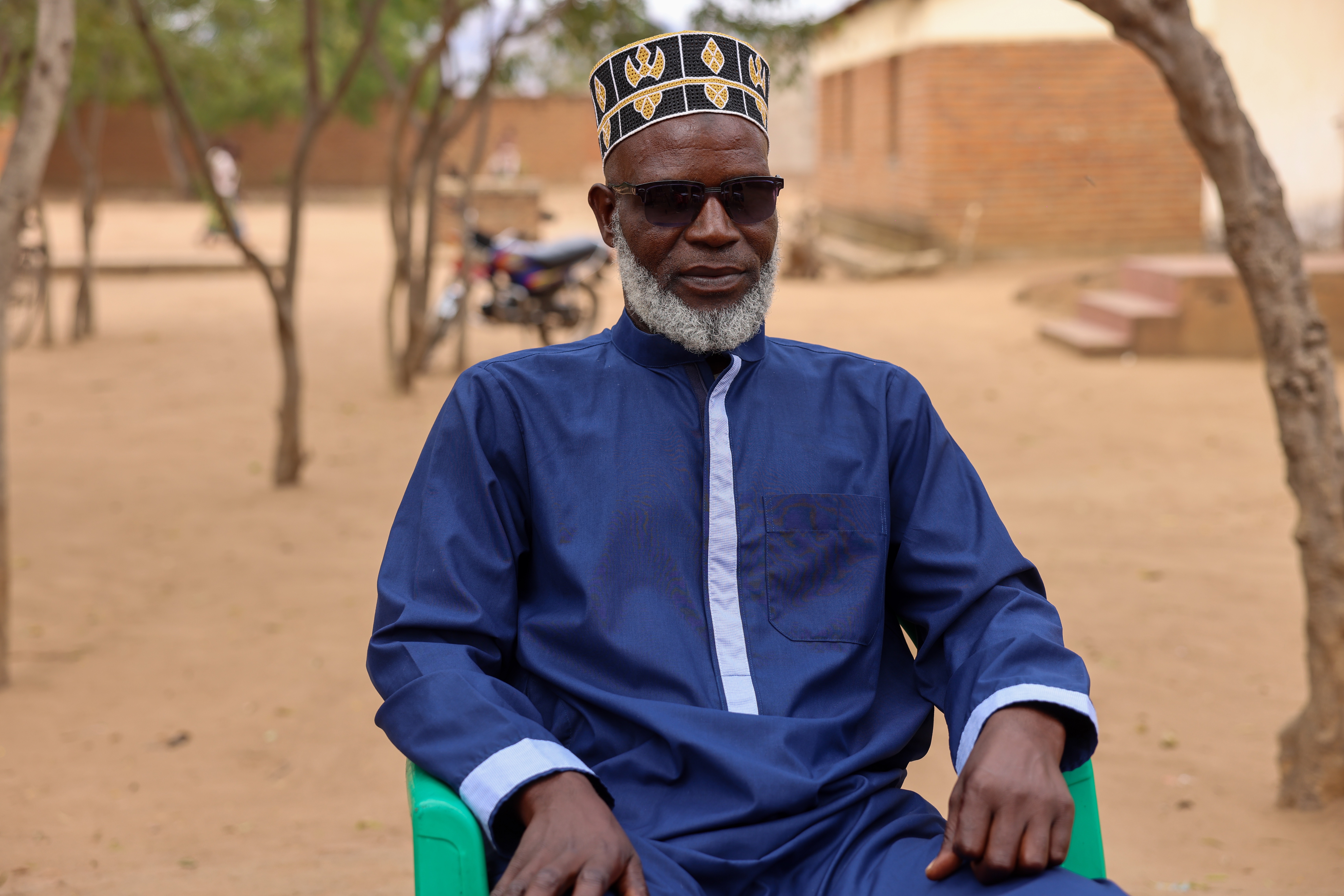
Sheikh Rajab Ntewa’s leadership and teaching has been key to ending child marriage in his area.

In Malawi’s Dedza and Zomba Districts, community-driven transformation respects existing power structures while redirecting them towards positive outcomes.
For generations in Malawi’s Dedza District, the intersection of faith and tradition created complex problems that often led young girls to early marriages.
The district, known for its cool climate and forested peaks, is located in the central western part of the country. Historically, the Islamic communities here relied on religious schools, or madrasas, as their primary form of education. Many families did not prioritize formal schooling, especially for young girls, which made it easier for child marriages to thrive.
This religious framework intersected with the traditional chinamwali initiation ceremony that formalized the transition from childhood to marriage. Girls, some as young as ten or twelve, were declared ready for adult responsibilities after completing cultural rites that included having sex with older men in a practice known as “cleansing”.
In order to end early marriage, the challenge facing communities was therefore not just to change practices but to reimagine the very foundations of what religious and traditional authorities had been teaching for generations.
When GASO CBO (Grassroots Action and Support Organisation), Firelight’s local partner in Dedza, began working with the communities to end child marriage, they encountered resistance rooted in spiritual conviction. Those devoted to following Islamic law initially could not understand why outsiders would question divinely ordained practices. Meanwhile, traditional leaders had always overseen initiation ceremonies that were integral to cultural identity and community cohesion. The weight of centuries seemed to stand against any suggestions of change.
Guided by the principles of community-driven systems change, which Firelight follows across its programming, GASO CBO came to appreciate the value of working within existing systems and power structures. This insight became the foundation for a collaborative strategy that would transform communities from within by engaging the very authorities who had previously perpetuated harmful practices. Instead of leaving these leaders out of the program, GASO worked with them.
Sheikh Rajab Ntewa’s evolution demonstrates how religious leaders can reframe sacred texts within contemporary contexts. Initially, he held a traditional religious view that “when a child reaches an age where she says she wants to get married, she should be allowed, because if she is not, she will end up getting pregnant and this will become the sins of the parent.”
Within the Muslim community’s religious framework, the logic seemed sound; they believed it was better to marry young than risk sin. However, through exposure to broader perspectives, the Sheikh came to understand the negative effects of child marriage.
Now a child protection advocate, Sheikh Ntewa utilizes every opportunity, in market centres, mosques or at funerals, to spread awareness about the perils of child marriage. His message carries weight precisely because it comes from him, from within the faith community. When he speaks about protecting children, people listen because they understand that it is not an indication of him abandoning his faith but rather of him deepening his understanding of it.
This is the path taken by Reverend Charles Sitolo, a Christian pastor for the Assemblies of God in Malosa in Zomba District to the southeast. He and his fellow pastors, who “preach the gospel against child marriages”, see their work as a key part of a community-wide effort supported by Tikwonde CBO. Despite their many successes, they know that changing the culture takes time. To that end, they were in the midst of carrying out a new monthlong outreach campaign.
“We are trying to teach people how bad this practice is,” said Reverend Sitolo, “so we thank God that people are now taking the message.”
Back in Dedza, and parallel to these religious evolutions, Senior Group–Village Headman Charles Brown embarked on a process to transform the traditional systems that had long governed community life. His efforts were in support of his Senior Chief Theresa Kachindamoto, whose strong stance against child marriage across the wider district laid a foundation for this work.
Brown’s influential position provided firsthand insight into how cultural systems and practices around initiation were enabling child marriages. Unlike religious leaders who could reinterpret the doctrine, traditional leaders faced the challenge of maintaining cultural identity while eliminating harmful practices embedded within well-regarded ceremonies. The critical question was how they could preserve what defines their communities while at the same time protecting its most vulnerable members, girls and young women.
A sustainable solution was identified through GASO CBO's respectful partnership approach. “Unlike other organizations that would just come in the community and then inform me that they are going to do this and this in my area, GASO CBO consulted me from the beginning”, said Chief Brown.
This deliberate action created a working relationship that respected and promoted his authority while channelling it toward child protection. It enabled him to become a champion of positive change while remaining a custodian of his people's cultural identity.
Traditional initiation ceremonies in Dedza have been completely reformed under this collaborative approach. Where girls were once subjected to forced sexual encounters and declared ready for marriage after cultural rites, they are now mentored by older women on puberty, sexuality, womanhood and the importance of staying in school. This transformation has preserved cultural identity while eliminating harmful elements. It shows how traditional practices can evolve to protect rather than endanger children. While the ceremonies still mark the transition to womanhood, they now prepare girls for education and empowerment instead of early marriage. The government has supported this practice by developing a manual for the initiators.
The collaborative efforts have created comprehensive community-owned accountability systems. Charles Brown, under the leadership of Senior Chief Kachindamoto, worked with communities to develop and adhere to bylaws on ending child marriages with penalties for violations. These local justice mechanisms command respect because they emerged from recognized authority. As a penalty for taking bribes to officiate child marriages, 19 chiefs were demoted by Senior Chief Kachindamoto. The enforcement of these bylaws has proven so effective that there are zero reported child marriages in the community today.
Because the community itself developed the rules and now enforce them, compliance has become a matter of collective responsibility. This success has attracted national and global attention, with communities from across Malawi and the world visiting Dedza District to learn from the model.
Chief Charles Brown attributes this success to comprehensive stakeholder involvement. “The secret to succeeding”, he said, “is to involve all the key stakeholders right from the start the way GASO CBO involved us from the start.”
The strategy created unified messaging that reached every corner of community life. Change became inevitable when the Sheikh and the Chief started saying the same things and when the mosque and village meetings consistently delivered similar messages. The result was more awareness, with religious and traditional leaders working together to end child marriage while respecting their overlapping constituencies.
This effort continues. “I feel it is important for religious leaders to continue working with traditional leaders because the same people that meet with traditional leaders meet with religious leaders”, says Sheikh Ntewa. “When they hear the same thing on Friday, Saturday and Sunday from all leaders, then this will help end early child marriage.”
By redirecting the power of traditional authority structures towards child protection, the model has proven effective. Religious leaders maintained their spiritual authority while using it to promote education and delayed marriage. Traditional leaders preserved their cultural role while transforming harmful practices into protective ones.
It has been seen as such an effective approach that the community members now apply it to other challenges. As Charles Brown noted, “We are now using the community-driven system change approach to even address other community issues because we have seen how it works.”
The model has created a template for community-driven transformation that respects existing power structures while redirecting them towards positive outcomes. The same voices and authority figures who once perpetuated child marriage and harmful traditions are now champion its elimination and protecting the children for whom they care.